Water Softeners in Cedar Rapids, Iowa
Sized to your actual hardness, installed in a day, and backed for five years. This is the fix for the scale, the spots, and the water heater that keeps dying.
Why Cedar Rapids homes need softening
Corridor water comes out of limestone country, and it shows. Cedar Rapids city tap averages about 7 grains per gallon even after the city's lime softening — and once you leave city water it jumps: Marion runs 18–20, Hiawatha 14–20, and private wells around 23. Anything over 10.5 is classified “very hard.” That mineral load is what crusts your faucets white, films your glassware, stiffens your laundry, and quietly shortens the life of every appliance that touches hot water.
A whole-home water softener removes that hardness at the point where water enters your house, so every tap, every fixture, and every appliance downstream runs on soft water. It's the single highest-impact fix for a hard-water house — everything else is treating symptoms.
Who actually needs a softener — and who doesn't
Not every house needs every system, so here's the honest sort. You almost certainly benefit from a softener if you're on city water in the corridor and you can see the evidence — scale on fixtures, spotted glasses, towels that come out stiff, or a water heater that didn't make it past year eight. The math is simple: the hardness is in the water every day, so the damage compounds every day.
You may not need one if your home already has a working softener that just needs service, or if your complaint is strictly about drinking-water taste — that's a reverse osmosis job, and it's cheaper. And if you're on a private well, don't buy anything until the water's tested: wells around here often carry iron loads that change which equipment is right, and an ordinary softener specced wrong is money down the drain.
- Scale, spots, stiff laundry, short-lived water heater → softener.
- Taste, odor, or chlorine complaints only → reverse osmosis or filtration, not a softener.
- Orange staining or rotten-egg smell → iron & sulfur treatment first, softener second.
- On a well → test first, always. The right treatment train depends on what's actually in it.
How a softener actually works
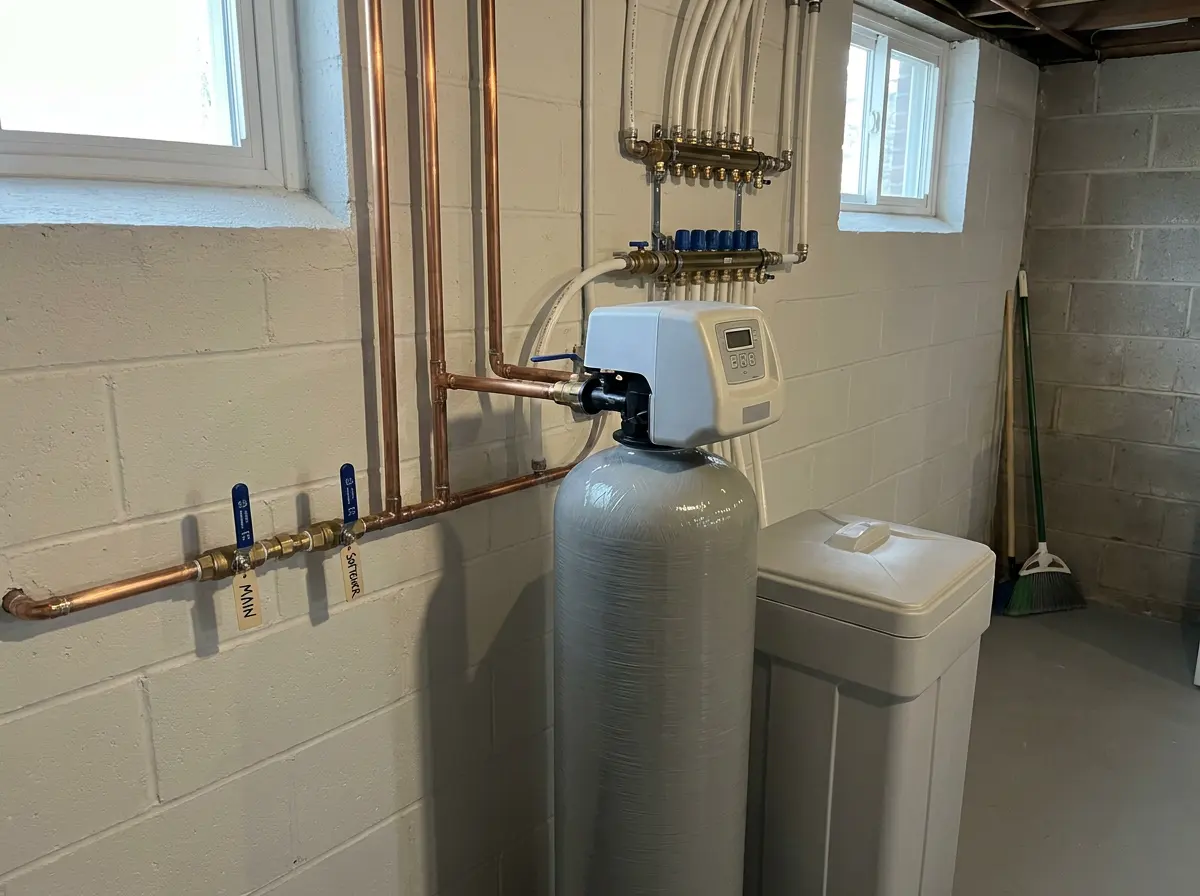
Inside the tall tank is a bed of resin beads that trade ions: as water passes through, the beads grab the calcium and magnesium (the hardness) and release sodium in exchange. Downstream of that tank, your water is soft — the minerals never reach your plumbing.
Every few days the system pauses (usually at 2 a.m.) and rinses the collected minerals off the resin with brine from the salt tank, flushes them down the drain, and gets back to work. That's why you add salt: it's not going into your water in any meaningful amount — it's cleaning the resin.
What we install
- Metered, demand-based systems — they regenerate based on how much water you actually used, not a dumb timer. Less salt, less water, less money.
- Sized from your test, not a catalog — grain capacity matched to your measured hardness, household size, and iron level. An undersized unit exhausts early and lets hardness through; an oversized one wastes your money up front.
- Iron-handling configurations — plenty of corridor homes, especially on wells, carry enough iron to foul a standard softener. We spec for it or pair the softener with an iron filter when the numbers say so.
- Clean, labeled installs — bypass valve, labeled shutoffs, tidy plumbing you can actually understand. The install photo above is our standard, not our best day.
What a water softener costs in Cedar Rapids
The honest answer is a range, because the right system depends on your water and your house. As a rule of thumb for a professionally installed, properly sized system:
| Situation | Typical installed range |
|---|---|
| Standard city-water home, average hardness | $1,800 – $2,800 |
| Larger home or high hardness / some iron | $2,500 – $3,800 |
| Well water with significant iron (softener + iron filter) | $3,500 – $6,000+ |
In one sentence: a professionally installed water softener in Cedar Rapids typically costs between $1,800 and $3,800, depending on hardness, iron, and home size.
What moves the number: your measured hardness and iron, household size, plumbing access, and whether a drain and outlet are already where the system goes. We test first, then quote the real figure in writing — no phone-guess pricing, no surprise line items on install day.
Running cost: figure a bag or two of salt a month (about $6–8 a bag) and a small bump in water use from regeneration. Most families make that back in detergent, soap, and appliance life alone.
Softener vs. “salt-free conditioner” — the honest version
You'll see “salt-free softeners” advertised. They aren't softeners. Salt-free conditioners alter how minerals crystallize so scale sticks a little less — the hardness is still in your water, still filming your glass, still in your water heater. In a hard-water corridor, we'll tell you straight: if you want soft water, there's one technology that delivers it, and it uses salt. If you mainly want better drinking water, that's a different job — see reverse osmosis.
Install day
- Free water test — hardness, iron, chlorine at your kitchen sink, numbers explained in plain English.
- Written quote — the system, the size, the price. Valid whether you say yes today or in June.
- Installation — typically 2–4 hours. Bypass valve so you can service it without shutting the house down. We haul the packaging, test the output, and show you the settings.
- After — expect fully soft water within a day as your water heater turns over. Salt reminders and our 5-year workmanship warranty come standard.
Asked at almost every kitchen table.
Will softened water taste salty?
No. The sodium added by ion exchange is small — on Cedar Rapids hardness, a glass of softened water carries less sodium than a slice of bread. If you want sodium-free drinking water, we pair the softener with a reverse-osmosis tap at the sink.
What size softener do I need?
It's math, not guesswork: hardness (grains per gallon) × people × gallons per person per day tells us your daily grain load, and we size the resin capacity so the system regenerates about once a week. That's why we test before we quote.
How long does a water softener last?
A quality metered unit that's sized right and serviced occasionally runs 10–15 years, often more. The resin wears out faster if it's fighting iron it wasn't specced for — one more reason the water test matters.
Can I keep my existing softener and just have it fixed?
Often, yes. If the unit is sound and just mis-set, fouled, or has a worn valve, a service call is far cheaper than a replacement — and we'll tell you which one it is.
Do you service Marion, Hiawatha, and the smaller towns?
Yes — Cedar Rapids, Marion, Hiawatha, Robins, Fairfax, Ely, North Liberty, and Coralville. Same pricing, same warranty, wherever you are in the corridor.
Find out what your water is doing.
Free in-home test: hardness, iron, chlorine — real numbers, plain English, and a written quote only if you want one.